
Resources and books for ministers, worship leaders, church members and all spiritual people
W H Allen
This Could Be Our Future - Print
This Could Be Our Future - Print
Couldn't load pickup availability
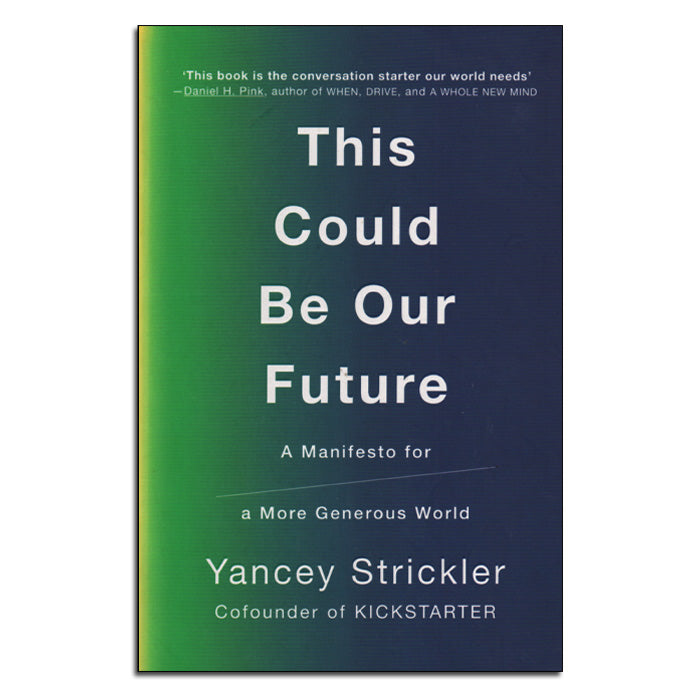
This Could Be Our Future
A Manifesto for a More Generous World
By Yancey Strickler
[1 copy only in stock at this reduced price 2 July 2026
We will not be re-ordering this title when this copy has sold]
A bold and hopeful manifesto that challenges society’s obsession with money and invites readers to imagine a more generous, purposeful and sustainable future.
This book will help you:
- Rethink the assumption that money should be the highest measure of value.
- Understand how self-interest, scarcity and competition shape modern life.
- Explore a broader vision of value that includes community, purpose, sustainability and fairness.
- Consider practical ways to make decisions that serve both present and future generations.
- Reflect on how businesses, institutions and individuals can move beyond financial maximisation.
- Develop a more generous framework for personal choices, leadership and social change.
- Imagine a future shaped by abundance, creativity, responsibility and shared wellbeing.
Features
- A manifesto for building a more generous world.
- Written by the cofounder of Kickstarter.
- Explores how Western society became dominated by financial maximisation.
- Introduces a values-based way of thinking beyond money alone.
- Hopeful, practical and creative, with concrete ideas for social and cultural change.
Soft cover, 285pp
6" x 9" x 1.8 cm
ISBN 9780753552834
W H Allen (2019)
Description
What if the future does not have to be shaped by scarcity, competition and the relentless pursuit of more?
This book offers a powerful challenge to one of the dominant assumptions of modern life: that the best decision is the one that makes the most money. Instead, it invites readers to imagine a society that values what makes life meaningful—community, purpose, fairness, sustainability, creativity and care for those who come after us.
Drawing on his experience as cofounder of Kickstarter, Yancey Strickler examines how Western society became trapped by three limiting ideas: that life is about maximising self-interest and wealth, that individuals are locked in an adversarial world, and that this arrangement is natural and inevitable. These assumptions narrow imagination, separate people from one another and make it difficult to picture a better future. The book argues that the solution is not to reject money altogether, but to stop treating money as the only value that counts.
At the heart of the book is a call to expand our definition of value. By giving rational weight to values such as community, responsibility, purpose and sustainability, individuals and institutions can begin making choices that serve more than immediate profit. This shift opens up new possibilities for business, culture, politics and everyday decision-making. A world organised around financial maximisation alone produces anxiety and scarcity; a world that recognises many forms of value can move toward generosity and abundance.
Hopeful but realistic, this is a book for entrepreneurs, leaders, creatives, activists, students and thoughtful readers who sense that the current system is too small for the future we need. It offers a clear critique of the world as it is, but also a practical and imaginative road map toward the world we are capable of making.
About the Author
Yancey Strickler is a writer, speaker and cofounder of Kickstarter, the crowdfunding platform that has helped creative projects find support around the world. He has written and spoken widely on creativity, culture, technology, value and the future of society. He has been recognised by outlets and organisations including Fortune, Vanity Fair and the World Economic Forum, and has been profiled in major international media. His work often explores how people and institutions can build systems that support creativity, generosity and values beyond financial gain.
Contents
Introduction to a more generous future
The limits of financial maximisation
The assumptions shaping Western society
How money became the dominant measure of value
Why self-interest alone cannot sustain a meaningful society
Community, purpose and sustainability as real forms of value
The relationship between scarcity and abundance
New frameworks for personal and institutional decision-making
Practical ideas for businesses, leaders and communities
A road map for building a fairer and more imaginative future
Reflections on generosity, creativity and long-term responsibility